
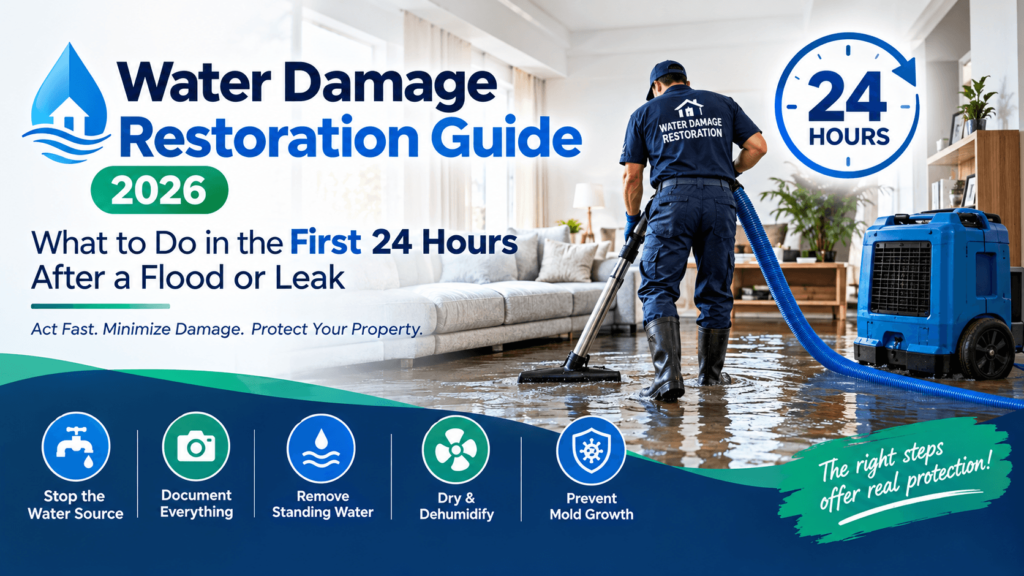
Water is already moving through your walls. That is certainly not an overly dramatic opening statement for a water damage guide that is simply the truth of what occurs from the time that a pipe breaks, a basement floods, or a roof leaks and no one notices for a few hours. Water is going to move into sub-floors, wicks up drywall, saturates insulation, and gets into structural framing far before any surface is dried. Those initial decisions made in the first 24 hours after water damage will determine how much damage occurs.
This water damage guide discusses what really is occurring in your structure, what you should be doing, what you need to avoid, and when you need to call in a specialist for water damage restoration.
Why the First 24 Hours Are Not a Cliché
The time window between 24 and 48 hours before the start of the mold colonization process is referred to again and again in restoration literature, and there are valid reasons behind that. As per the guidelines issued by the U.S. Environmental Protection Agency, mold can develop after 24 to 48 hours in wet building materials. The temperature, humidity levels, and the material that is affected all play a role in how soon the growth starts.
Apart from the formation of mold, other physical problems arise as well due to the passage of time. Wood starts swelling up. The drywall paper gets separated from the gypsum layer. Insulation materials lose their insulation value and act as moisture sponges. In terms of the IICRC S500 Standard for Professional Water Damage Restoration, which is the standard for the entire restoration industry, the longer materials stay wet, the worse the situation gets.
Water damage is another type of damage that can lead to expensive homeowners’ insurance claims in the US. According to the Insurance Information Institute, one in four of all homeowners’ insurance claims are made due to water damage or freezing, and the average cost of claims has increased substantially recently. Prompt actions do not only depend on saving your home; the outcome has a direct impact on what your insurance company is going to pay.
Understand What Type of Water You Are Dealing With
Not all floods are the same, and the type of water affects how you will clean up. Restorers deal with three types of water, and it is crucial for one to know about them before doing anything.
- Category 1 (Clean Water): Has its source from a clean origin, like burst water supply pipes, a leaking sink without any dangerous material, or a burst water heater. It is the safest form of water damage and the easiest to manage, although it can escalate to a Category 2.
- Category 2 (Gray Water): The contamination level that may lead to sickness or pose any other health risks. It could be an overflow from washers, dishwashers, and aquariums. Gloves and boots should definitely be worn.
- Category 3 (Black Water): Severely Contaminated. The instances of water contamination in this category are sewage overflow, water run-off from rivers or stormy conditions, and stagnant water containing bacteria. Biohazard cleanup measures should be implemented in this category. Exposure to Category 3 water without proper protective equipment poses genuine health risks.
In the case that the water source is questionable, it should be assumed that the water is Category 2 or worse. The presence of sewage requires sewage backup cleanup because the contamination cannot be seen with naked eyes, and cleaning will not remove the bacteria present in it.
Step-by-Step: What to Do in the First 24 Hours
1. Stop the Source If It Is Safe to Do So
The first and foremost concern is the prevention of any further flow of water into the building. In case of a leaking pipe, it is important to find the master shut-off valve and close it. In case of a leak from an appliance, the appliance itself and the water line that feeds it need to be shut off.
Do not enter a flooded basement or any flooded area where electrical outlets, boxes, and other devices may become submerged. This would constitute a very dangerous situation involving water and electricity. In case of any uncertainty regarding electrical safety, turn off electricity at the breaker box first.
2. Document Everything Before Touching Anything
Take pictures of everything prior to moving any furniture or pulling up any carpets. This is crucial as proof for insurance purposes. Take pictures of the water level, the water’s origin, all affected rooms, and any damaged items. Insurance companies always ask for proof of the original state of damage.
3. Remove Standing Water as Quickly as Possible
It should be removed as quickly and efficiently as possible. Small amounts can be handled by a wet/dry vac, but the water that comes from flooding a basement or bursting pipes cannot be handled by one. This machine can remove several thousand gallons much faster than a consumer wet/dry vac.
Speed matters here. The water damage gets worse the longer you wait to extract the water. Therefore, the sooner Emergency water extraction is done, the shorter the time needed for drying, and the fewer materials will be removed.
4. Move Salvageable Contents Out of the Wet Zone
The furniture, carpets, electrical devices, documents, and personal effects need to be moved to a dry place. The wet carpets which are found to be on the floor will hasten the process of deterioration of the sub-floor. The metal legs of the furniture will cause permanent stains on the carpet.
5. Increase Air Movement and Reduce Humidity
Ensure that windows are opened in case of low humidity outside the building compared to the humidity inside. Turn on all the fans available since they will help promote evaporation at the surface. In case you have a dehumidifier, ensure you use it.
The distinction is important because consumers are basically air movers, but commercial LGR (Low Grain Refrigerant) dehumidifiers and desiccants use psychrometry, which involves decreasing the vapor pressure gradient between saturated surfaces and air; that’s how moisture gets extracted from wood, drywall, and concrete. Moisture meters and infrared cameras could identify places where moisture absorption has taken place even within walls and under apparently dry floor surfaces.
What Happens Inside the Structure That You Cannot See
It is here that most DIY techniques fail. When water that is visible gets eliminated, moisture keeps moving. The concrete slab absorbs and retains moisture. Subfloor plywood swells and may delaminate. The fiberglass batt insulation in walls becomes saturated with water, which remains there permanently unless the insulation is removed. Even when the outer layer that has been painted is dried, the paper inside the drywall, which is organic material, remains wet.
The professionals use moisture meters and thermal imaging to identify these wet areas that remain hidden. Without such a procedure, the materials that seem to be dry could still contain moisture higher than the threshold of mold growth. The threshold of acceptable moisture levels for various materials is defined by the IICRC S500 standard. Achieving this threshold involves both moisture extraction and structural drying.
Basement flooding adds another layer of complexity. Hydrostatic pressure, the force of water-saturated ground pushing against the foundation walls, may allow water to penetrate concrete walls even after draining the standing water. This kind of situation is quite common for households where the water table level is very high or where the drainage system is weak outside the building. This indicates that in some cases, Basement flood cleanup cannot be dealt with just by removing water.
A Practical Decision Table: What Your Situation Likely Requires
| Situation | Water Category | Immediate Action | Professional Need |
| Burst supply pipe, small area affected | Category 1 | Shut off water, extract with wet vac, document. | Recommended within hours if subfloor or walls are wet |
| Washing machine overflow, soaked flooring | Category 2 | Wear gloves, extract, move contents, document. | Strongly recommended, gray water degrades quickly |
| Sewage backup | Category 3 | Do not touch without full PPE; evacuate the area. | Required biohazard protocol necessary |
| Basement flooding from storm | Category 2 or 3 | Do not enter if electrical risk exists; document from outside. | Required volume and contamination exceed DIY capacity |
| Slow hidden leak discovered late | Category 1 or 2 | Stop sourcing, document, and check for mold signs. | A required mold assessment is likely needed |
The table above is only an indicator of guidance. The category of the water damage and the degree of structural penetration need to be determined by the restorer using moisture detection equipment, especially when dealing with walls, subfloors, or insulation.
What Not to Do After Water Damage
Several common reactions to water damage make the situation significantly worse.
- Never use a standard vacuum cleaner on wet surfaces. Standard vacuum cleaners are not designed to work on water and may be damaged easily.
- Do not operate the HVAC system during flooding. The HVAC system may circulate the contaminated air and mold spores all around the building.
- Never assume the floor to be dry simply because it feels dry. Moisture meters will indicate a high reading for a floor material that is completely dry to the touch.
- Do not dispose of the damaged materials until the adjuster comes. Early disposal of flooring, drywall, or personal property will lower the covered amount.
- Do not use the fan only as a method of drying after a water damage situation. Without proper dehumidification, the fan will distribute moisture into undamaged areas.
- There is no point in hoping that it will dry up on its own. Mold growth is fast, and materials that do not dry quickly must be replaced.
Insurance and Water Damage: What Is Generally Covered
Homeowners’ insurance policies in the USA usually provide coverage for damage that happens suddenly and unexpectedly due to water, such as bursting pipes, malfunctioning appliances, and rainwater coming through a damaged roof due to storms. However, these policies do not cover gradual leaks, damage from wear and tear, or flooding due to rising water levels outside that requires the National Flood Insurance Program (NFIP).
The distinction between sudden and gradual is important. A pipe that bursts overnight is typically covered. The gradual dripping from behind the wall, which caused damage over a period of time, may be disputed as a problem that should have been identified by the homeowner, as it was one of maintenance items. Another point of importance in making claims is the timely recording of the incident.
As per data published by the Insurance Information Institute, water damage is among the leading causes of claims made by homeowners each year. Professionals involved in restoration work who are knowledgeable about filing insurance documents will be able to document the extent of the damage done.
When DIY Is Not Enough
Equipment made for consumers and cleaning supplies found at home can deal with any minor cases of water damage that occur, like a leak from an appliance that is detected in a matter of minutes or a spill that occurred on a tile floor. However, when it comes to any water damage involving carpets, drywall, subflooring, etc., the difference is great.
Professional rapid drying services have equipment that is adjusted according to the moisture load and type of materials. The logs of the process monitor the temperature, humidity, and moisture content at certain intervals to ensure that the materials reach an acceptable level of moisture and not just become dry.
The more extensive water restoration process, which includes assessment, extraction, structural drying, antimicrobial treatment, and finally restoration, is a process that occurs in a very specific order for a reason. Cutting corners because things look better is how callbacks for mold and smell come about weeks later.
How to Connect With a Restoration Professional Quickly
In times of a water emergency, the time taken to look for an experienced professional is the time when the damage is being done. Property owners, whether homeowners, landlords, or commercial property owners, can use a reliable Water Damage Restoration Service to connect with reputable local contractors across the country. This linking process occurs all day and night long since water damage respects no business hours.
The network connects distressed property owners with vetted local professionals who handle the full range of water damage situations from burst pipe cleanup to storm damage restoration to large-scale flood events. The referral network is not a direct service provider; the contractors connected through the network are independent licensed professionals.
In case of an undetected and/or slow leak that has come to light only after it has occurred, emergency leak cleanup and moisture inspection will help in checking whether the secondary damage has started. The water damage cleanup deals with the last stage of cleaning after the drying process is completed.
The first 24 hours post-flood or leakage incident are crucial. This period is when damage will be done; however, any damage done at this time can be prevented with good decisions but cannot be undone if ignored.